"I Feel Hopeful" — Inside Ag Day on the Hill
Legislator meetings, goat milk, hummus, Hollywood actors and hope.
Food as a verb thanks
for sponsoring this series

Note to reader: Today's story comes from writer, hunter and horsewoman Madison Baldwin, who's also a member of the Southeast Tennessee Young Farmers Coalition, (SeTNYF).
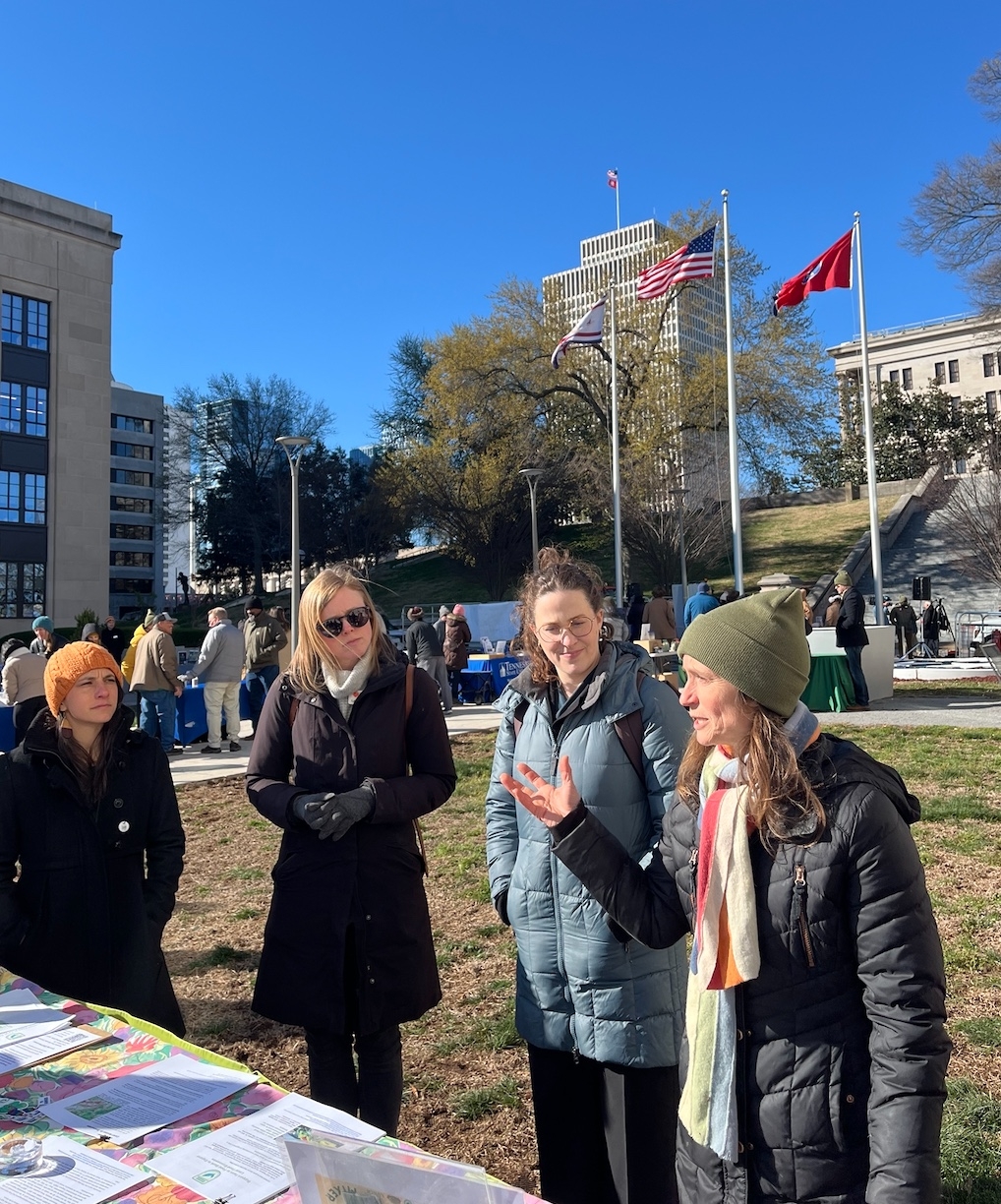
On Tuesday, March 17, she and 100s of other Tennessee citizens traveled to Nashville to meet with legislators on food and agricultural issues. The day is known as "Ag Day."
This is her first-hand account. All photos are contributed; all quotes recorded.
"I Feel More Hopeful: Inside Ag-Day on the Hill"
Words and contributed photos by Madison Baldwin
In the 2020s, primary avenues for policy advocacy have shifted to virtual means — “Text 1234 to contact your Rep” (and then be pinged for a $10 donation for umpteen weeks), phone calls and fill-in forms with email scripts.
When I have used these contact methods, it feels like a solo endeavor, kind of like commenting on Youtube videos.
And ... do they work?
I am not suggesting that we stop calling and emailing our reps or forwarding policy alerts via text. But I am emphatically saying that there is no substitute for a good, old-fashioned face-to-face visit with lawmakers.
Welcome to Ag Day on the Hill.
Ag Day is the designated invitation for farmers, agriculture-focused organizations — like the Southeast Tennessee Young Farmers, or SeTNYF, the organization I attended with — industry partners, and stakeholders to head to the State Capitol and speak with our lawmakers.
Getting There - 6:45 am, Tuesday, March 17, 2026
We headed west over Monteagle. Snow coated the ground and the trees as we glided over the mountain at sunrise.
We’d been preparing for weeks, thanks to Jess Wilson and Emily Dudley, SeTNYF’s leaders.
SeTNYF's state level policy priorities for 2026 were identified as soil health, land access, PFAS (per-and polyfluoroalkyl substances) protections for farmers, and farm-to-food bank funding.
Our plan: to respectfully engage and offer tangible policy recommendations to address the challenges that young, beginning, BIPOC and aspiring farmers face in Tennessee.
The strategy: sharing stories and the realities of small farming.
Where's the support for young farmers that commodity farming gets? How do you begin to farm when a few acres cost more than your annual salary? How do we respond to weather disasters, market fluctuations and more?
That morning, the Cordell Hull Building in downtown Nashville felt more like a livestock show than a state house.
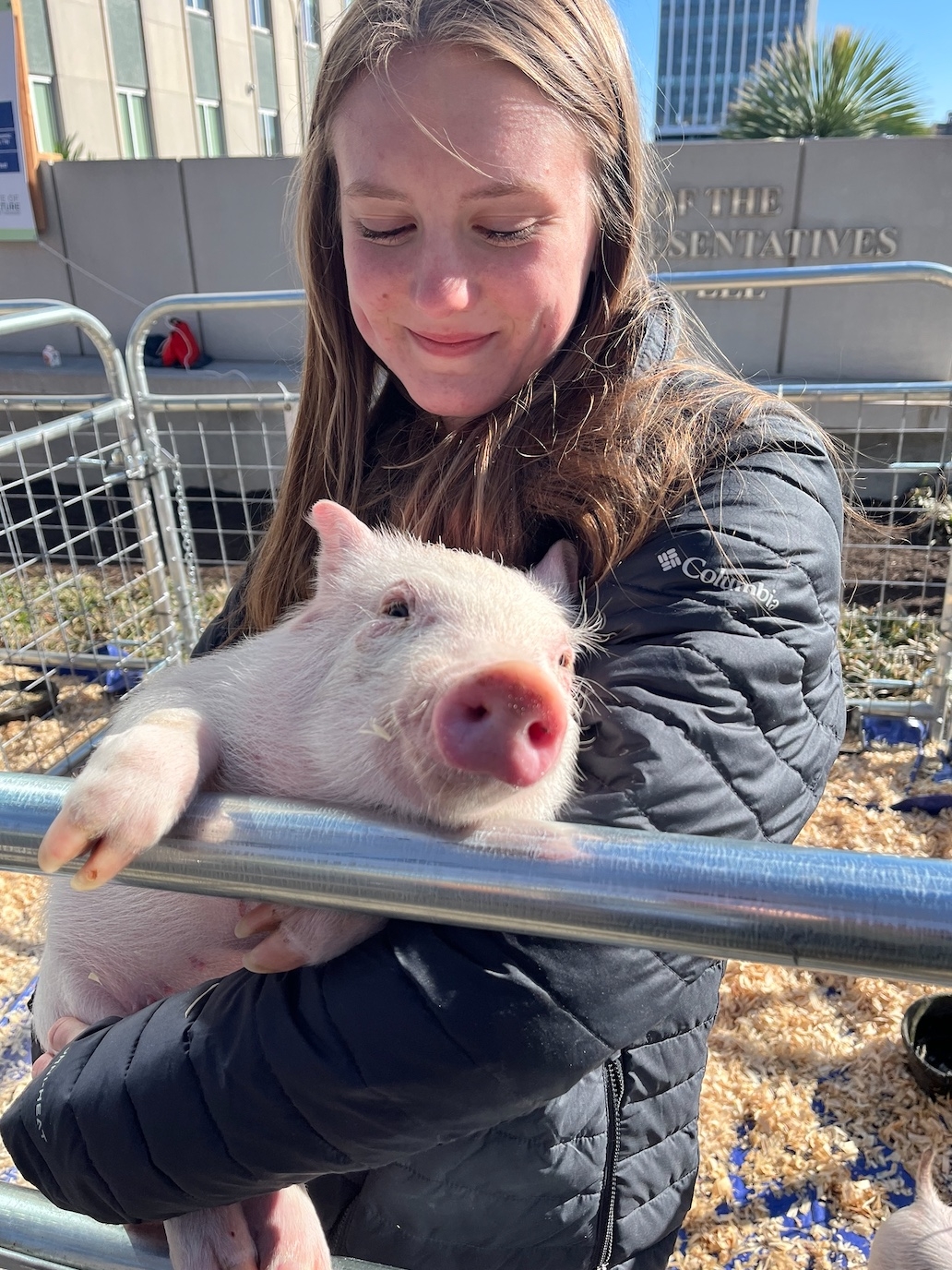
Farm Bureau, Tennessee Farmers Cooperative, UT Institute of Agriculture and a slew of other exhibitors transformed the sidewalks to more closely resemble barn aisles, with haltered show steers and piglets in temporary stalls.
SeTNYF and company filed into the building and shook off the cold, forming a line that felt like the airport.
“Smartwatches off! All metal out of your pockets!”
The security officer cracked a smile and shooed me along through the metal detector when I asked her if I needed to remove my dumb watch.
Professionals at the capitol added green into their formal dress on this St. Patrick’s Tuesday and several men donned cowboy hats, perhaps inspired by Commissioner of Agriculture Andy Holt, who's rarely seen without one.
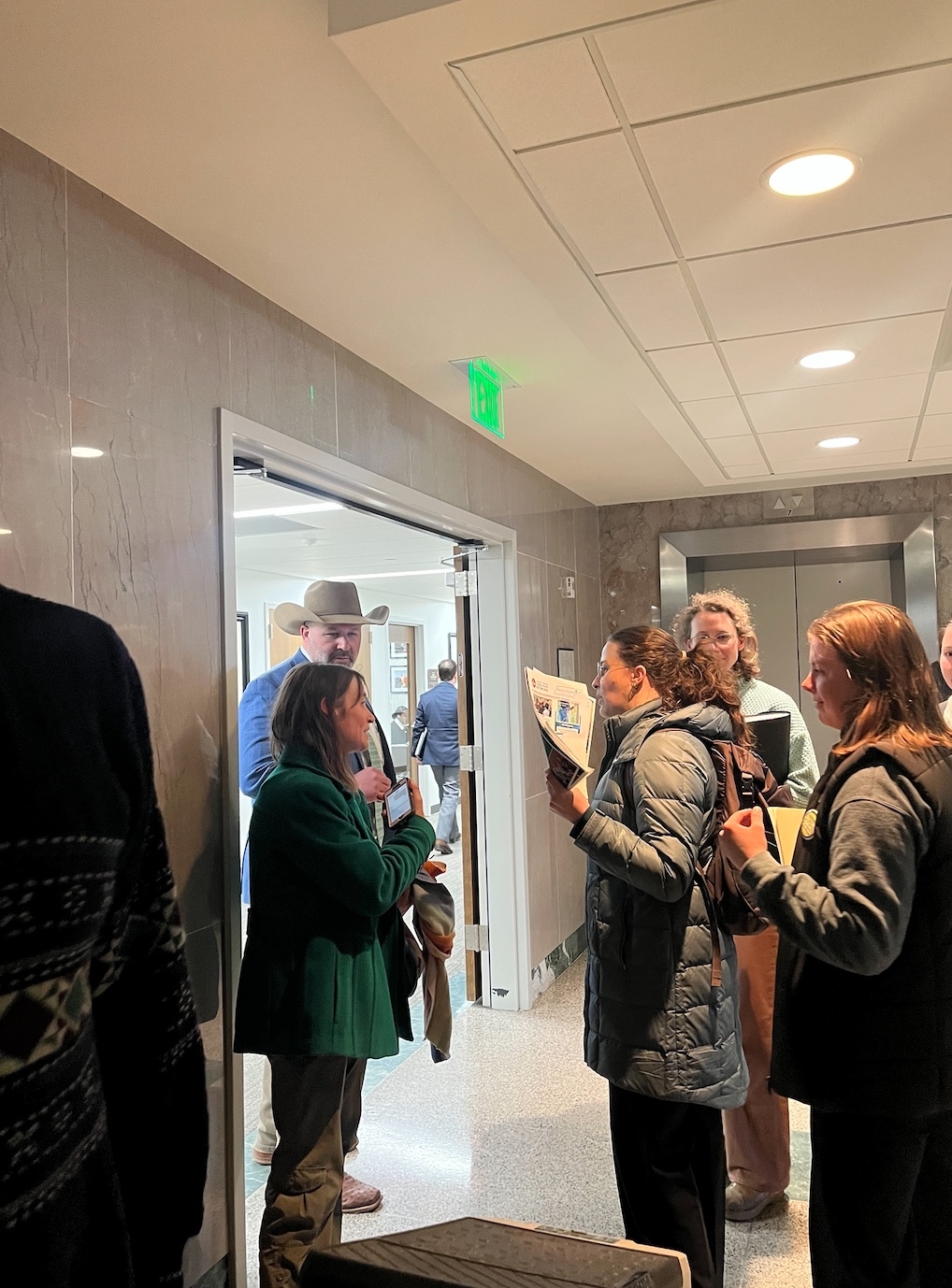
Our First Meeting - Rep. Michele Reneau (R-Signal Mountain), 10 am.
In the waiting room of Rep. Michele Reneau’s office, her busy legal assistant pointed out the constituent map covered in pushpins. Mattie Sienknecht, a shepherd and SeTNYF's co-chair, tracked her home base on the map with her finger and marked the spot.
A few minutes behind schedule, Rep. Reneau arrived and our meeting began with a couple of introductions and flowed right into chatting about the Tennessee Data Center Impact Review Act that she introduced this session. HB 2392 was on the SeTNYF radar due to the propensity of data centers around the country being built on former, yet still arable farmland.
Rep Reneau informed us that HB 2392 had just been taken off notice due to commerce-related conflicts.
The rest of our 20-minute meeting was friendly; Rep. Reneau seemed like she wanted to collaborate. Truthfully, I braced for impact before this meeting, unsure where the conversation would go. SeTNYF is an openly progressive organization and Rep. Reneau is a proven conservative.
We listened as Rep. Reneau shared about her background supporting local foodways in the District 27 area and championing legislation protecting herd share sales in her early days in the House.
I sat across from her desk and listened as Rep. Reneau expressed her desire to advance Tennesseans' access to fresh, healthy, unprocessed foods. She talked about the commonality of Victory Gardens in America’s past and returning to this as a strategy for better health outcomes. A white Trump Force Captain hat was displayed behind the glass of her desk hutch, a canvas print of her family portrait taken in Coolidge Park hung on the wall left of her office chair.
Much of her focus this legislative session has revolved around food. Rep. Reneau filed HB 1853 to remove artificial food dyes from school lunches and HJR 0780 the Food Freedom Act, promoting individuals rights to save seeds and produce their own food on private property.
Marked by a group photo, our time came to a close. Emily Dudley re-extended our invitation to Rep. Reneau as a guest at our lunchtime Ag Power Hour.
Our Second Meeting - Senator Rusty Crowe (R-Johnson City) 11:30 am.
A large breed, droopy-eyed dog surveyed us from his cozy kennel in the corner pocket of the office. Sen. Rusty Crowe said the dog is a rescue and sleeps in the bed with him most nights.
We introduced ourselves and began to speak about why we were here today, addressing the loss of federal farm to food bank funding in 2025, and the necessity to replenish this deficit with state dollars.
“We need to do much, much more in Tennessee to fund our food banks. I love the notion of partnering our farmers with the food banks. It is such a great approach,” said Sen. Crowe. “When I asked Commissioner Bryson ... last year [2025] for a million dollars [for food bank funding], we got half a million and it’s split five ways.”
Tim and Michele Roberts of Dogwood Valley Farm in Apison produce A2 goat milk. Tim toted a portable electric refrigerator around the Capitol and into Sen. Crowe’s office to share their milk and their farm to food bank funding testimony. Namely, they would not have survived their first year in business without it.
“When we first started, people were like ‘eh, goat milk?’,” said Tim. “We started out giving a few quarts to the food bank to try and then people are coming in specifically requesting the goat milk, especially people who are lactose intolerant.”
Tim spent many years as a dairyman in New York and Florida, so crafting the product itself was not a learning curve, but keeping up with the farm input costs was almost untenable.
“We have made it into some local grocery stores, but without the food bank, I don’t know how we would have made it,” he said.
“They can take as much as you can make, I bet,” said Sen. Crowe.
“They want more,” said Michele, “It just depends on how much of the grant money we have left, so we have to pace it out.”
Across from me, Shannon Moore — Chattanooga Area Food Bank’s Chief Communication Officer —advocated for a recurring line item in the state budget to endow a farm-to-food bank funding program.
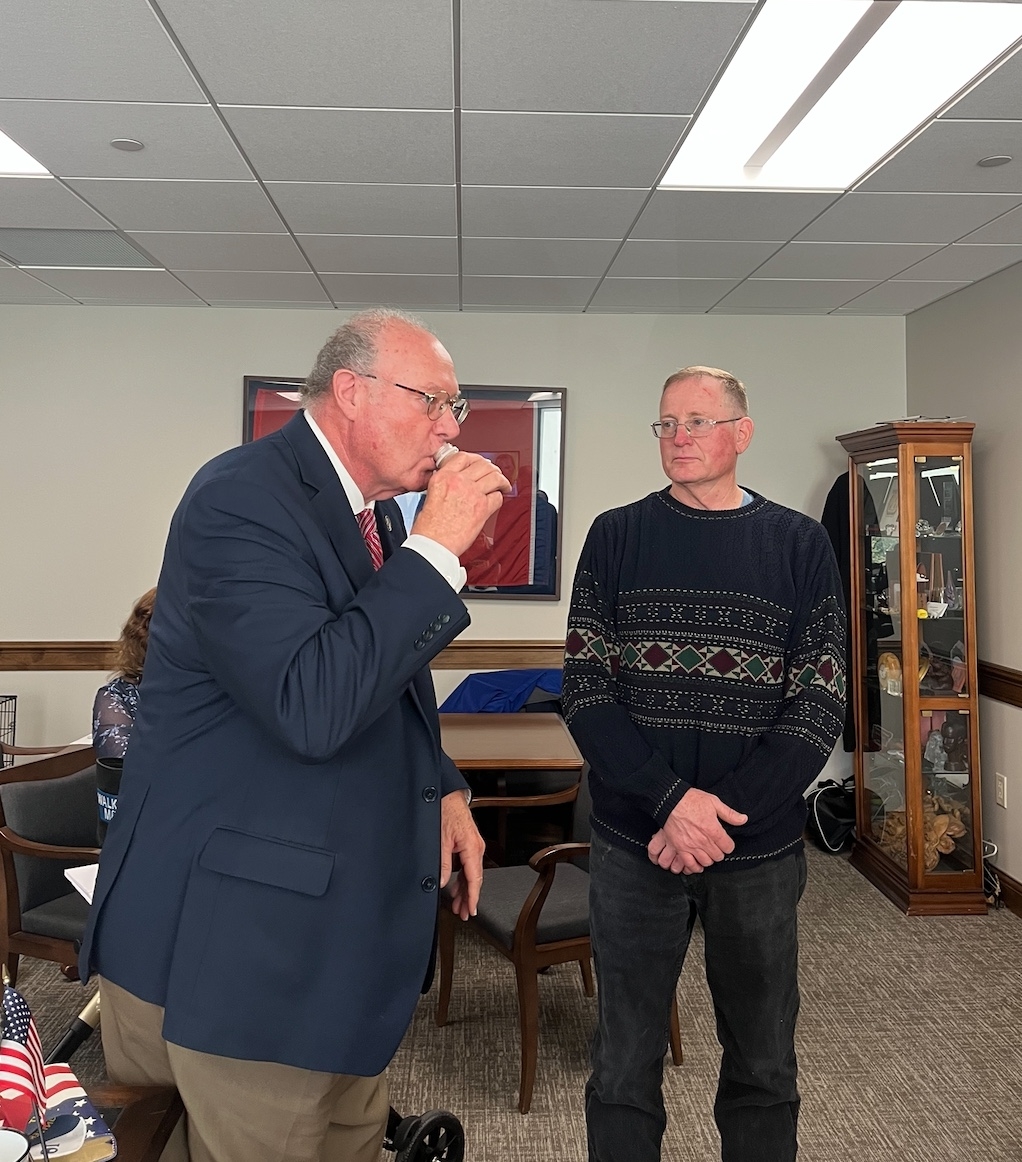
Sen. Crowe agreed with the necessity of this. Then, Sen. Crowe circled back to the goat milk. He was ready to taste one of the food bank’s most popular products. Tim produced a chilled half pint of the chocolate variety from their mini-fridge on wheels.
Tim instructed the Senator to shake the half pint, as the goat milk is pasteurized but not homogenized.
“It’s straight from the goat. We haven’t designed a chocolate goat yet, so we had to add that in,” said Tim.
The Senator took a swig, “Man, that’s good!”
Meeting Three - Representative Monty Fritts (R- Kingston), 12 pm.
Ali Simpson and I took our seats at a conference table beneath a decorative wall hanging of the Second Amendment. Our target discussion point for this meeting was land access, as Representative Monty Fritts was one of the only No votes on last year’s Tennessee Farmland Preservation Act.
Simpson, a farmer and SeTNYF co-chair, introduced herself to Rep. Fritts as his constituent and potentially, his successor. Simpson is running for the District 32 seat in the Tennessee State House this year.
“Really? Good for you,” said Rep. Fritts.
Last election cycle, Rep. Fritts ran unopposed for the District 32 seat and he is currently running for Governor.
When asked how he would plan to help sustain small farms or increase access to farmland should he become Tennessee’s next governor.
“Putting more money in your pocket as a Tennessean is the best thing that I as a governor could do for you,” said Rep. Fritts.
Simpson respectfully disagreed, pointing out that if someone can’t afford the land to begin with, an even lower tax rate would likely not increase affordability.
“See, I don't know that I agree with that,” said Rep. Fritts, “We have lots of people that want to incentivize with other people's money. They want to reach into your pocket to fund your endeavor. There was a time that was called theft. Now we call it programs. [The Tennessee Farmland Preservation Act] was indeed reaching into y'all's pocket and allowing a bureaucrat in Nashville to decide who benefits from that.”
The conversation flowed into a discussion of federal funding for larger commodity farms and the fairness of how resources are allocated.
The friendly and productive discussion among folks who hold different world views felt like it could have been happening at a kitchen table.
Back to farmland affordability, Ali and I brought up Tennessee’s low wages, a moot point considering Rep. Fritts’ stances. He didn’t respond defensively, but restated what he considered to be a solution — lower taxes, more money to the citizens. It was a conversation, not a boxing match.
“We can argue like cats and dogs ... And I'm gonna assert that I'm right until you prove me wrong … But we ought to be able to sit down,” said Rep. Fritts.
As we gathered our coats, Simpson and Rep. Fritts shook hands and wished each other luck on the campaign trail this year.
Power Hour - Lunch with Representative Justin Jones (D- Nashville), 1 pm.
We unwrapped cheese and fanned out bread options across tables, as the Power Hour lunch co-hosted by Rep. Justin Jones began. Rep. Jones and David Arquette, the famous actor who has become a Nashville-area farmer, sat in the inner middle of the U-shaped conference table.
They both listened attentively as everyone in the room introduced themselves in a round-robin. Each participant shared what they hoped to see for the future of agriculture in Tennessee:
Thriving local food hubs.
Young farmers succeeding and entering the market.
Farm to school programs.
Expanded farmer services.
Rep. Jones recorded notes on a yellow legal pad as everyone spoke; he took no break to fix himself a plate. Rep. Reneau arrived and Rep. Jones paused to acknowledge her entry. Arquette hopped up from his seat and held his suede cowboy hat to his chest, to offer Rep. Reneau his chair at the room’s center.
Rep. Reneau kindly declined and remained standing for the duration of her brief visit. She thanked the room of farmers and local agriculture advocates for attending Ag Day and cited the necessity of speaking our priorities to our legislators.
“This is your Capitol,” said Rep. Reneau. “I hope you visit often and let your voices be heard.”

Jess Wilson spoke on SeTNYF’s policy areas: funding soil health practices, PFAS protections for farmers should they have unknowingly contaminated their land, building on land access initiatives, and increasing small farm income streams.
“We are interested in developing a soil health bill. There are really two avenues for this - soil conservation districts and also recognizing soil health improvements as key to productivity. We want to see soil health done through [Tennessee Ag Enhancement Program] TAEP, so you can do your cost share through TAEP for soil health equipment … Maybe even electronet fencing. As a small ruminant farmer, that is something I am always asking for,” she said.
Wilson acknowledged that federal funding has historically been available for soil health measures, but with the uncertainty and fluctuation of federal dollars, the state would do well to step up for farmers.
Rep. Jones weighed in that the Agriculture and Natural Resources Committee is still trying to understand the incoming Commissioner's position on the issues presented by Wilson.
“Since we began our session, I requested for the Ag Commissioner to come before the committee and answer some questions. They gave us 15 minutes with no questions, no Q&A. So basically, he [Commissioner Holt] gave a presentation about how agriculture is going great in Tennessee and that’s not the reality…But I think this [Agriculture and Natural Resources] is really the one committee where you're seeing bipartisanship. And so that's why it's not hopeless," he said.
Rep. Jones is a member of both the Agriculture and Natural Resources Committee and Subcommittee. He said folks assumed that as a representative of an urban district, he might not enjoy the assignments or be able to contribute meaningfully.
Instead, he has become increasingly passionate about the committee’s subject matter and plugged himself into the agriculture community within and surrounding his district.
He’s a horseman and, for his 30th birthday, gave himself a mustang he calls Zani — short for Wicozani — with a freeze brand on his crest, like all mustangs who have moved through the US Bureau of Land Management corrals.
He shared with us that he recently drew on his experience horseback riding at the Duck River to help advance legislation to permanently protect the biodiverse waterway as a Scenic River.
“With the federal and state government, it doesn’t seem like there are going to be a lot of advances with these administrations in power,” said Rep. Jones.
Instead? Wilson and Rep. Jones encouraged us to go local.
Join local Farm Bureau chapters, attend meetings and point out the disconnect with their values and lobbyist actions.
Support and grow Appalachian RC&D’s Tennessee FarmLink land connection platform across all corners of the state.
Seek land use planning resources and provide input for local governments to plan for agriculture in all communities.
Continue efforts to build a coalition that can provide an alternate perspective around agriculture in Tennessee.
Wrapping Up - 2:20 - 4 pm.
We met with Representative Greg Martin (R - Hixson), the Chair of the Agriculture & Natural Resources Subcommittee. As we shared about SeTNYF’s Urban Agriculture initiatives, Helaina Gomez of the TN Aquarium Conservation Institute and Kelsey Freshour of SeTNYF leadership encouraged Rep. Martin to visit Crabtree Farms as an example of thriving Urban Ag in action.
As a final rally, we were able to visit with Representative Esther Helton-Haynes (R- East Ridge), who also voiced support for advancing urban agriculture in District 30.
Throughout the day and again at the close, I’d been asking members of the group whether or not they thought in person advocacy was worth the effort and if it made them feel more or less hopeful about farming.
Did commuting, dressing up, using PTO or taking unpaid time off work to come and visit with lawmakers contribute to real change?
Answers were positive and nuanced.
It does depend which legislator you are talking to. Taking up space and breaking the fourth wall as farmers, a group routinely pedestaled in politics, allows us to establish what really matters to us. Lawmakers hearing the truth directly from the source is invaluable.
Most of all, I loved what Mattie Sienknecht, my SeTNYF colleague and friend, said:
“I feel more hopeful, not necessarily because of the responses we got from politicians, but because of the diverse and passionate group of farmers, activists and organizers we were with," she said. "Whether they listen or not, it's a powerful feeling to go into a politician's office with a group of like-minded, motivated folks and ask for the change that we need to see for farmers and food systems in our state.”
I remember coming back home from last year's Ag Day; I felt downright electric about the experience. The bill we were there to champion made its way into law as the Tennessee Farmland Preservation Act.
This year, though, the political turmoil around the country that's made its way into my community sat heavy on my shoulder as I walked into the state house.
But on my other shoulder, there was obstinate optimism.
It’s my right to be in the offices of my elected officials. What is it good for if I don’t use it? The possibility of progress is what motivates me to keep going, working toward a future that may cease to exist by the time I can afford to achieve it.
It is impossible to discern if our stories weighed on all the lawmakers we met with. But I am proud to keep the company of people who are working for change in one way or another.
Connecting communities, providing resources, running for public office, hosting events, attending county commission meetings, growing our food and sharing it with neighbors. I hope you can say the same about the company you keep. I hope your voter registration is up to date. I hope you attend a single local government meeting or volunteer day this year.
The mud tires on my old Toyota squeaked down the spiral ramp of the downtown Nashville parking garage and spit us out toward the Eastbound interstate, back to Chattanooga where the work continues.
Update - Saturday, March 28, 9 am.
Only several days after Ag Day, Senator Charlane Oliver submitted amendment #016800 to fund a Farm-to-Food Bank program in Tennessee.
Please see Jess Wilson’s comprehensive update and contact your representatives in support of this measure.
Author’s Note: The author’s opinion is her own and does not reflect that of all members of Southeast Tennessee Young Farmers or that of her employer.
She can be reached at madisonkbaldwin@gmail.com.
Story ideas, questions, feedback? Interested in partnering with us? Email: david@foodasaverb.com
This story is 100% human generated; no AI chatbot was used in the creation of this content.
Note to reader: Today's story comes from writer, hunter and horsewoman Madison Baldwin, who's also a member of the Southeast Tennessee Young Farmers Coalition, (SeTNYF).
On Tuesday, March 17, she and 100s of other Tennessee citizens traveled to Nashville to meet with legislators on food and agricultural issues. The day is known as "Ag Day."
This is her first-hand account. All photos are contributed; all quotes recorded.
"I Feel More Hopeful: Inside Ag-Day on the Hill"
Words and contributed photos by Madison Baldwin
In the 2020s, primary avenues for policy advocacy have shifted to virtual means — “Text 1234 to contact your Rep” (and then be pinged for a $10 donation for umpteen weeks), phone calls and fill-in forms with email scripts.
When I have used these contact methods, it feels like a solo endeavor, kind of like commenting on Youtube videos.
And ... do they work?
I am not suggesting that we stop calling and emailing our reps or forwarding policy alerts via text. But I am emphatically saying that there is no substitute for a good, old-fashioned face-to-face visit with lawmakers.
Welcome to Ag Day on the Hill.
Ag Day is the designated invitation for farmers, agriculture-focused organizations — like the Southeast Tennessee Young Farmers, or SeTNYF, the organization I attended with — industry partners, and stakeholders to head to the State Capitol and speak with our lawmakers.
Getting There - 6:45 am, Tuesday, March 17, 2026
We headed west over Monteagle. Snow coated the ground and the trees as we glided over the mountain at sunrise.
We’d been preparing for weeks, thanks to Jess Wilson and Emily Dudley, SeTNYF’s leaders.
SeTNYF's state level policy priorities for 2026 were identified as soil health, land access, PFAS (per-and polyfluoroalkyl substances) protections for farmers, and farm-to-food bank funding.
Our plan: to respectfully engage and offer tangible policy recommendations to address the challenges that young, beginning, BIPOC and aspiring farmers face in Tennessee.
The strategy: sharing stories and the realities of small farming.
Where's the support for young farmers that commodity farming gets? How do you begin to farm when a few acres cost more than your annual salary? How do we respond to weather disasters, market fluctuations and more?
That morning, the Cordell Hull Building in downtown Nashville felt more like a livestock show than a state house.
Farm Bureau, Tennessee Farmers Cooperative, UT Institute of Agriculture and a slew of other exhibitors transformed the sidewalks to more closely resemble barn aisles, with haltered show steers and piglets in temporary stalls.
SeTNYF and company filed into the building and shook off the cold, forming a line that felt like the airport.
“Smartwatches off! All metal out of your pockets!”
The security officer cracked a smile and shooed me along through the metal detector when I asked her if I needed to remove my dumb watch.
Professionals at the capitol added green into their formal dress on this St. Patrick’s Tuesday and several men donned cowboy hats, perhaps inspired by Commissioner of Agriculture Andy Holt, who's rarely seen without one.
Our First Meeting - Rep. Michele Reneau (R-Signal Mountain), 10 am.
In the waiting room of Rep. Michele Reneau’s office, her busy legal assistant pointed out the constituent map covered in pushpins. Mattie Sienknecht, a shepherd and SeTNYF's co-chair, tracked her home base on the map with her finger and marked the spot.
A few minutes behind schedule, Rep. Reneau arrived and our meeting began with a couple of introductions and flowed right into chatting about the Tennessee Data Center Impact Review Act that she introduced this session. HB 2392 was on the SeTNYF radar due to the propensity of data centers around the country being built on former, yet still arable farmland.
Rep Reneau informed us that HB 2392 had just been taken off notice due to commerce-related conflicts.
The rest of our 20-minute meeting was friendly; Rep. Reneau seemed like she wanted to collaborate. Truthfully, I braced for impact before this meeting, unsure where the conversation would go. SeTNYF is an openly progressive organization and Rep. Reneau is a proven conservative.
We listened as Rep. Reneau shared about her background supporting local foodways in the District 27 area and championing legislation protecting herd share sales in her early days in the House.
I sat across from her desk and listened as Rep. Reneau expressed her desire to advance Tennesseans' access to fresh, healthy, unprocessed foods. She talked about the commonality of Victory Gardens in America’s past and returning to this as a strategy for better health outcomes. A white Trump Force Captain hat was displayed behind the glass of her desk hutch, a canvas print of her family portrait taken in Coolidge Park hung on the wall left of her office chair.
Much of her focus this legislative session has revolved around food. Rep. Reneau filed HB 1853 to remove artificial food dyes from school lunches and HJR 0780 the Food Freedom Act, promoting individuals rights to save seeds and produce their own food on private property.
Marked by a group photo, our time came to a close. Emily Dudley re-extended our invitation to Rep. Reneau as a guest at our lunchtime Ag Power Hour.
Our Second Meeting - Senator Rusty Crowe (R-Johnson City) 11:30 am.
A large breed, droopy-eyed dog surveyed us from his cozy kennel in the corner pocket of the office. Sen. Rusty Crowe said the dog is a rescue and sleeps in the bed with him most nights.
We introduced ourselves and began to speak about why we were here today, addressing the loss of federal farm to food bank funding in 2025, and the necessity to replenish this deficit with state dollars.
“We need to do much, much more in Tennessee to fund our food banks. I love the notion of partnering our farmers with the food banks. It is such a great approach,” said Sen. Crowe. “When I asked Commissioner Bryson ... last year [2025] for a million dollars [for food bank funding], we got half a million and it’s split five ways.”
Tim and Michele Roberts of Dogwood Valley Farm in Apison produce A2 goat milk. Tim toted a portable electric refrigerator around the Capitol and into Sen. Crowe’s office to share their milk and their farm to food bank funding testimony. Namely, they would not have survived their first year in business without it.
“When we first started, people were like ‘eh, goat milk?’,” said Tim. “We started out giving a few quarts to the food bank to try and then people are coming in specifically requesting the goat milk, especially people who are lactose intolerant.”
Tim spent many years as a dairyman in New York and Florida, so crafting the product itself was not a learning curve, but keeping up with the farm input costs was almost untenable.
“We have made it into some local grocery stores, but without the food bank, I don’t know how we would have made it,” he said.
“They can take as much as you can make, I bet,” said Sen. Crowe.
“They want more,” said Michele, “It just depends on how much of the grant money we have left, so we have to pace it out.”
Across from me, Shannon Moore — Chattanooga Area Food Bank’s Chief Communication Officer —advocated for a recurring line item in the state budget to endow a farm-to-food bank funding program.
Sen. Crowe agreed with the necessity of this. Then, Sen. Crowe circled back to the goat milk. He was ready to taste one of the food bank’s most popular products. Tim produced a chilled half pint of the chocolate variety from their mini-fridge on wheels.
Tim instructed the Senator to shake the half pint, as the goat milk is pasteurized but not homogenized.
“It’s straight from the goat. We haven’t designed a chocolate goat yet, so we had to add that in,” said Tim.
The Senator took a swig, “Man, that’s good!”
Meeting Three - Representative Monty Fritts (R- Kingston), 12 pm.
Ali Simpson and I took our seats at a conference table beneath a decorative wall hanging of the Second Amendment. Our target discussion point for this meeting was land access, as Representative Monty Fritts was one of the only No votes on last year’s Tennessee Farmland Preservation Act.
Simpson, a farmer and SeTNYF co-chair, introduced herself to Rep. Fritts as his constituent and potentially, his successor. Simpson is running for the District 32 seat in the Tennessee State House this year.
“Really? Good for you,” said Rep. Fritts.
Last election cycle, Rep. Fritts ran unopposed for the District 32 seat and he is currently running for Governor.
When asked how he would plan to help sustain small farms or increase access to farmland should he become Tennessee’s next governor.
“Putting more money in your pocket as a Tennessean is the best thing that I as a governor could do for you,” said Rep. Fritts.
Simpson respectfully disagreed, pointing out that if someone can’t afford the land to begin with, an even lower tax rate would likely not increase affordability.
“See, I don't know that I agree with that,” said Rep. Fritts, “We have lots of people that want to incentivize with other people's money. They want to reach into your pocket to fund your endeavor. There was a time that was called theft. Now we call it programs. [The Tennessee Farmland Preservation Act] was indeed reaching into y'all's pocket and allowing a bureaucrat in Nashville to decide who benefits from that.”
The conversation flowed into a discussion of federal funding for larger commodity farms and the fairness of how resources are allocated.
The friendly and productive discussion among folks who hold different world views felt like it could have been happening at a kitchen table.
Back to farmland affordability, Ali and I brought up Tennessee’s low wages, a moot point considering Rep. Fritts’ stances. He didn’t respond defensively, but restated what he considered to be a solution — lower taxes, more money to the citizens. It was a conversation, not a boxing match.
“We can argue like cats and dogs ... And I'm gonna assert that I'm right until you prove me wrong … But we ought to be able to sit down,” said Rep. Fritts.
As we gathered our coats, Simpson and Rep. Fritts shook hands and wished each other luck on the campaign trail this year.
Power Hour - Lunch with Representative Justin Jones (D- Nashville), 1 pm.
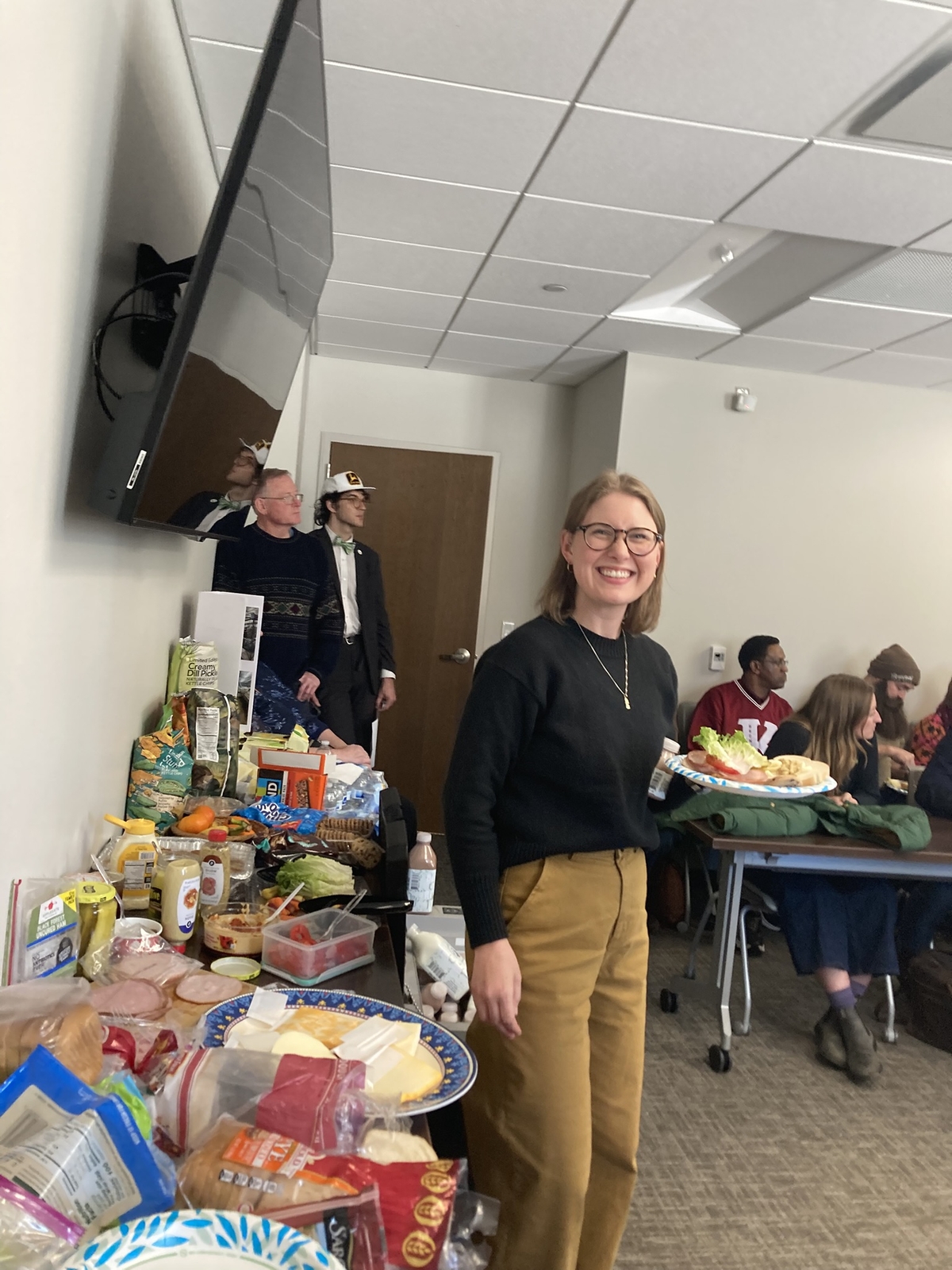
We unwrapped cheese and fanned out bread options across tables, as the Power Hour lunch co-hosted by Rep. Justin Jones began. Rep. Jones and David Arquette, the famous actor who has become a Nashville-area farmer, sat in the inner middle of the U-shaped conference table.
They both listened attentively as everyone in the room introduced themselves in a round-robin. Each participant shared what they hoped to see for the future of agriculture in Tennessee:
Thriving local food hubs.
Young farmers succeeding and entering the market.
Farm to school programs.
Expanded farmer services.
Rep. Jones recorded notes on a yellow legal pad as everyone spoke; he took no break to fix himself a plate. Rep. Reneau arrived and Rep. Jones paused to acknowledge her entry. Arquette hopped up from his seat and held his suede cowboy hat to his chest, to offer Rep. Reneau his chair at the room’s center.
Rep. Reneau kindly declined and remained standing for the duration of her brief visit. She thanked the room of farmers and local agriculture advocates for attending Ag Day and cited the necessity of speaking our priorities to our legislators.
“This is your Capitol,” said Rep. Reneau. “I hope you visit often and let your voices be heard.”
Jess Wilson spoke on SeTNYF’s policy areas: funding soil health practices, PFAS protections for farmers should they have unknowingly contaminated their land, building on land access initiatives, and increasing small farm income streams.
“We are interested in developing a soil health bill. There are really two avenues for this - soil conservation districts and also recognizing soil health improvements as key to productivity. We want to see soil health done through [Tennessee Ag Enhancement Program] TAEP, so you can do your cost share through TAEP for soil health equipment … Maybe even electronet fencing. As a small ruminant farmer, that is something I am always asking for,” she said.
Wilson acknowledged that federal funding has historically been available for soil health measures, but with the uncertainty and fluctuation of federal dollars, the state would do well to step up for farmers.
Rep. Jones weighed in that the Agriculture and Natural Resources Committee is still trying to understand the incoming Commissioner's position on the issues presented by Wilson.
“Since we began our session, I requested for the Ag Commissioner to come before the committee and answer some questions. They gave us 15 minutes with no questions, no Q&A. So basically, he [Commissioner Holt] gave a presentation about how agriculture is going great in Tennessee and that’s not the reality…But I think this [Agriculture and Natural Resources] is really the one committee where you're seeing bipartisanship. And so that's why it's not hopeless," he said.
Rep. Jones is a member of both the Agriculture and Natural Resources Committee and Subcommittee. He said folks assumed that as a representative of an urban district, he might not enjoy the assignments or be able to contribute meaningfully.
Instead, he has become increasingly passionate about the committee’s subject matter and plugged himself into the agriculture community within and surrounding his district.
He’s a horseman and, for his 30th birthday, gave himself a mustang he calls Zani — short for Wicozani — with a freeze brand on his crest, like all mustangs who have moved through the US Bureau of Land Management corrals.
He shared with us that he recently drew on his experience horseback riding at the Duck River to help advance legislation to permanently protect the biodiverse waterway as a Scenic River.
“With the federal and state government, it doesn’t seem like there are going to be a lot of advances with these administrations in power,” said Rep. Jones.
Instead? Wilson and Rep. Jones encouraged us to go local.
Join local Farm Bureau chapters, attend meetings and point out the disconnect with their values and lobbyist actions.
Support and grow Appalachian RC&D’s Tennessee FarmLink land connection platform across all corners of the state.
Seek land use planning resources and provide input for local governments to plan for agriculture in all communities.
Continue efforts to build a coalition that can provide an alternate perspective around agriculture in Tennessee.
Wrapping Up - 2:20 - 4 pm.
We met with Representative Greg Martin (R - Hixson), the Chair of the Agriculture & Natural Resources Subcommittee. As we shared about SeTNYF’s Urban Agriculture initiatives, Helaina Gomez of the TN Aquarium Conservation Institute and Kelsey Freshour of SeTNYF leadership encouraged Rep. Martin to visit Crabtree Farms as an example of thriving Urban Ag in action.
As a final rally, we were able to visit with Representative Esther Helton-Haynes (R- East Ridge), who also voiced support for advancing urban agriculture in District 30.
Throughout the day and again at the close, I’d been asking members of the group whether or not they thought in person advocacy was worth the effort and if it made them feel more or less hopeful about farming.
Did commuting, dressing up, using PTO or taking unpaid time off work to come and visit with lawmakers contribute to real change?
Answers were positive and nuanced.
It does depend which legislator you are talking to. Taking up space and breaking the fourth wall as farmers, a group routinely pedestaled in politics, allows us to establish what really matters to us. Lawmakers hearing the truth directly from the source is invaluable.
Most of all, I loved what Mattie Sienknecht, my SeTNYF colleague and friend, said:
“I feel more hopeful, not necessarily because of the responses we got from politicians, but because of the diverse and passionate group of farmers, activists and organizers we were with," she said. "Whether they listen or not, it's a powerful feeling to go into a politician's office with a group of like-minded, motivated folks and ask for the change that we need to see for farmers and food systems in our state.”
I remember coming back home from last year's Ag Day; I felt downright electric about the experience. The bill we were there to champion made its way into law as the Tennessee Farmland Preservation Act.
This year, though, the political turmoil around the country that's made its way into my community sat heavy on my shoulder as I walked into the state house.
But on my other shoulder, there was obstinate optimism.
It’s my right to be in the offices of my elected officials. What is it good for if I don’t use it? The possibility of progress is what motivates me to keep going, working toward a future that may cease to exist by the time I can afford to achieve it.
It is impossible to discern if our stories weighed on all the lawmakers we met with. But I am proud to keep the company of people who are working for change in one way or another.
Connecting communities, providing resources, running for public office, hosting events, attending county commission meetings, growing our food and sharing it with neighbors. I hope you can say the same about the company you keep. I hope your voter registration is up to date. I hope you attend a single local government meeting or volunteer day this year.
The mud tires on my old Toyota squeaked down the spiral ramp of the downtown Nashville parking garage and spit us out toward the Eastbound interstate, back to Chattanooga where the work continues.
Update - Saturday, March 28, 9 am.
Only several days after Ag Day, Senator Charlane Oliver submitted amendment #016800 to fund a Farm-to-Food Bank program in Tennessee.
Please see Jess Wilson’s comprehensive update and contact your representatives in support of this measure.
Author’s Note: The author’s opinion is her own and does not reflect that of all members of Southeast Tennessee Young Farmers or that of her employer.
She can be reached at madisonkbaldwin@gmail.com.
Story ideas, questions, feedback? Interested in partnering with us? Email: david@foodasaverb.com
This story is 100% human generated; no AI chatbot was used in the creation of this content.
Food as a verb thanks our story sponsor:
Food as a Verb Thanks our sustaining partner:
Food as a verb thanks our story sponsor:
Join our table

keep reading